
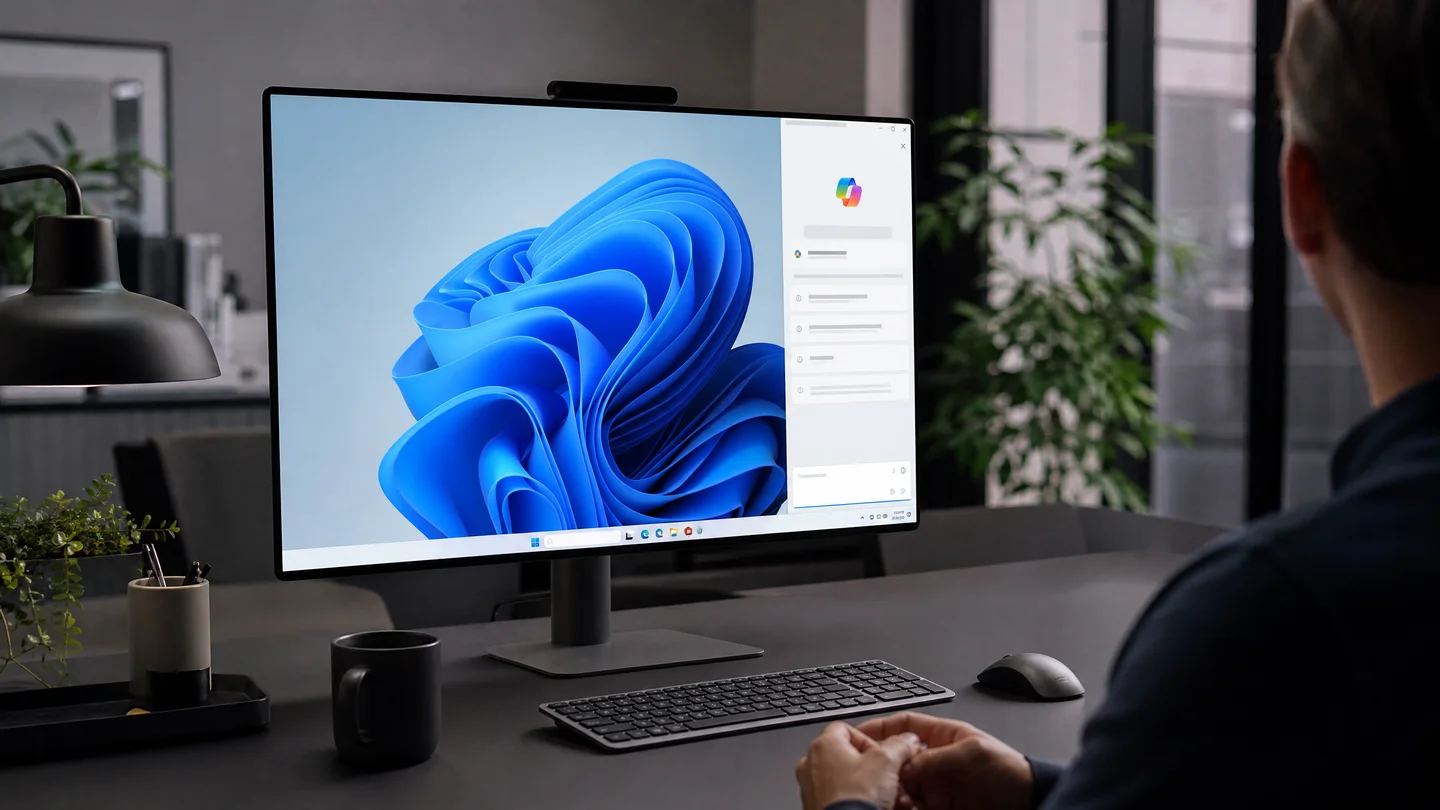
Windows Is Now an AI Agent OS. Should You Be Excited — or Worried?
Wevint Editorial
11 min read
Not Just a Feature. A Platform Redefinition.
At Build 2026 in San Francisco, Microsoft CEO Satya Nadella delivered a message that would have sounded like science fiction two years ago: Windows is no longer primarily a desktop environment for human-operated applications. It is now, structurally and by design, an operating system for AI agents — software entities that can observe, reason, and act autonomously on your behalf, across your entire computing environment.
The announcement wasn't framed as a product launch. It was a platform designation — and that distinction matters. Products are additions. Platform designations are rewrites of what the fundamental thing is.
🖥️ What Microsoft Actually Announced at Build 2026
Windows Copilot Runtime
A set of APIs and system services that transform the OS into an agent host — handling agent lifecycle management, context sharing, and secure inter-agent communication. Ships in preview in 2026, GA with the next major Windows 11 update.
On-Device AI Model Support
Local model capabilities on capable GPUs and CPUs, including Video Super Resolution and Speech Recognition. Seven new in-house MAI models announced by AI chief Mustafa Suleyman.
Cloud PC + Agent Containment
Agents can run in Cloud PCs with policy-defined security boundaries — "containment" for autonomous AI. Microsoft Execution Containers for sandboxed agent execution.
Microsoft 365 Autopilots
New category of AI agents that operate within work environments — email, calendar, documents — with minimal human input.
Microsoft IQ Unified Layer
Work IQ + Foundry IQ + Web IQ combine to give agents a live grounded view of the user's work context.
Project Solara + Project Volta
Solara: a chip-to-cloud platform for an open, multi-agent world. Volta: a new developer mini-PC (Nvidia Jetson Orin-class SoC, roughly book-sized) optimized for local AI inference.
The sheer volume of announcements — over 100 at Build 2026 — is itself a signal. This wasn't a product showcase. It was a platform commitment. Microsoft is betting that agents running natively on Windows will create a network effect so deeply embedded in productivity workflows that the installed base of 1.4 billion devices becomes effectively locked into the Copilot ecosystem. The $9.69 billion DoD contract — covering Microsoft 365, Azure, and AI Copilot services for the world's largest security organization — tells you something about how seriously enterprises are taking this, and how far the political calculation has already moved.
THE ERA OF AI AGENTS IS HERE, AND WINDOWS IS ITS OPERATING SYSTEM.— Satya Nadella, CEO Microsoft, Build 2026 Opening Keynote, June 2, 2026
The practical implications are vast. An AI agent running natively in Windows with access to the Copilot Runtime APIs can theoretically read your email, manage your calendar, interact with your files, run terminal commands, and communicate with external services — all on your behalf, all without you clicking a single button. For productivity, this is genuinely transformational. For privacy, it raises questions that Microsoft has not yet fully answered.
GitHub Copilot has also evolved significantly at this milestone — moving from an autocomplete assistant toward an autonomous developer that can build apps, run shell commands, and execute multi-step workflows, now packaged into a dedicated Windows desktop app.
Windows Agents See Everything You Do. How Exposed Are We Really?
The idea of an AI agent OS genuinely excites me. The vision of a system that knows your context, manages your calendar before you wake up, drafts your replies, and handles the repetitive overhead of digital life is compelling. That future is arriving.
But the surveillance question is real. An AI agent running at the OS level — with access to your files, your communications, your browsing, your work documents — is, by technical definition, the most comprehensive data collection layer ever deployed on a personal computer.
The honest frame, though: we're already that exposed, and the agent layer just makes it visible. Your browser already reports every site you visit. Your keyboard logs everything you type in telemetry. Your apps sync to the cloud. Windows Recall already captures screenshots periodically. The agent layer doesn't create a new surveillance architecture — it organizes one that already exists and makes it operational.
So the real question isn't whether an AI agent OS is more invasive than the current situation. It's whether the visibility is a net positive. A user who now understands that their OS has deep context access can make an informed choice. A user who never knew had no choice at all. That legibility, uncomfortable as it is, is arguably progress.
The DoD's $9.69 billion Microsoft 365 + Azure + AI Copilot contract suggests even the world's largest security organization has answered this question for their purposes. The question left is whether you've answered it for yours.
The uncomfortable answer to the surveillance question is that the data collection isn't new — the agent layer just makes it visible. Windows already sees your keystrokes, app usage, browsing history via Edge, and periodic screen captures via Recall. The agent doesn't start from zero. It starts from a baseline that most users have never examined, and it makes that baseline operational in a new way.
📘 The Containment Architecture
Microsoft introduced policy-defined boundaries for agents running in Cloud PCs — a governance layer that specifies what an agent can and cannot access. This is a meaningful safety design. The gap between "governance exists" and "governance is enforced correctly across 1.4 billion devices" is where most real-world privacy failures happen. The Copilot Runtime ships in preview this year — not general availability — which means there is a window to shape the defaults before they reach the full installed base.
Short, Medium & Long Run: The Agent OS Reality
⚡ Short Run — 2026
Power Users Adopt, Privacy Community Resists
Enterprise early adopters embrace Windows agent workflows and report productivity gains that are measurable within weeks — calendar management, email triage, and document automation are the obvious first use cases. Privacy advocates, EU regulators operating under GDPR Article 22 (automated decision-making), and enterprise security teams begin formal scrutiny simultaneously. The first agent authorization failures — agents that exceed their defined scope or access files outside their permission boundary — will be documented publicly within six months of general availability. These incidents won't be catastrophic, but they will define the governance conversation before GA.
📈 Medium Run — 2027–2028
The Regulatory Collision
GDPR and the EU AI Act enforcement phase arrives. Microsoft will be required to offer meaningful opt-out mechanisms, data minimization controls, and transparency about what agent workflows are doing with user data. The compliance UI will mirror the cookie-consent era — technically sufficient, practically ignored. Ninety-five percent of users will accept the default configuration without reading it. The defaults Microsoft sets during the preview period are therefore the de facto privacy policy for 1.4 billion devices. That's exactly why the preview window is the only meaningful moment to push for opt-in rather than opt-out on sensitive data categories.
🔭 Long Run — 2029+
The OS-Level Lock-In Bet
Agents running natively with full Windows Copilot Runtime access will build context over months — learning your work patterns, your contacts, your project history, your communication style. That accumulated context is not portable. An agent trained on your Microsoft 365 environment for two years cannot be exported to a competitor's platform. This is the most sophisticated lock-in architecture in computing history — not enforced through contracts or switching fees, but through the accumulated intelligence of the agent itself. If agents become essential to productivity, and if those agents run best on Windows, Microsoft doesn't need to lock you in. The intelligence cost of switching does it for them.
⚠️ The $9.69 Billion DoD Signal
The US Department of Defense signed a landmark $9.69 billion contract for Microsoft 365, Azure, and AI Copilot services. When the world's largest security organization decides that Microsoft's AI stack is acceptable for its most sensitive workloads, it sends a signal to enterprise buyers globally. It also raises the stakes for what "good enough" privacy governance means — and who gets to define it.
The Future Is Here. So Is the Reckoning.
The Windows AI Agent OS is not a privacy catastrophe waiting to happen. It is a genuinely powerful technological advance that will make computers more useful for hundreds of millions of people in measurable ways. Microsoft has designed containment architectures. They have published governance frameworks. This is not a company acting in bad faith.
But the "what if" this post raised — *how exposed are we already?* — is the question that makes the agent conversation honest. The agent layer isn't the beginning of Microsoft knowing everything about your digital life. It is the next chapter of a book that started being written a decade ago. The difference is that agents make the relationship transactional in a new way: you get productivity, and in exchange, an AI system with deep OS-level access becomes your most intimate digital collaborator.
That deal might be worth taking. Hundreds of millions of people have already made similar trades with Google, Apple, and Amazon. But you should make that trade with open eyes — understanding what you're exchanging, not just what you're receiving. The agent OS is the most consequential computing platform shift since the smartphone. Treat it with that level of seriousness.
Here's the shift in framing that actually resolves the surveillance question: the data collection isn't new. The agent just makes it visible. A user who now understands that their OS has deep context access can make an informed choice. A user who never knew had no choice at all. That legibility, uncomfortable as it is, is a net positive — and it comes with a narrow window. The Copilot Runtime ships in preview this year, not general availability. That distinction matters more than most users realize: the defaults set during preview are the defaults that reach 1.4 billion devices. Use the agent features. Audit the permissions in Windows Privacy Settings. Push for opt-in rather than opt-out on the sensitive stuff. The users who engage now shape what this looks like at GA. The ones who wait just inherit whatever Microsoft decided.
Post Tags: