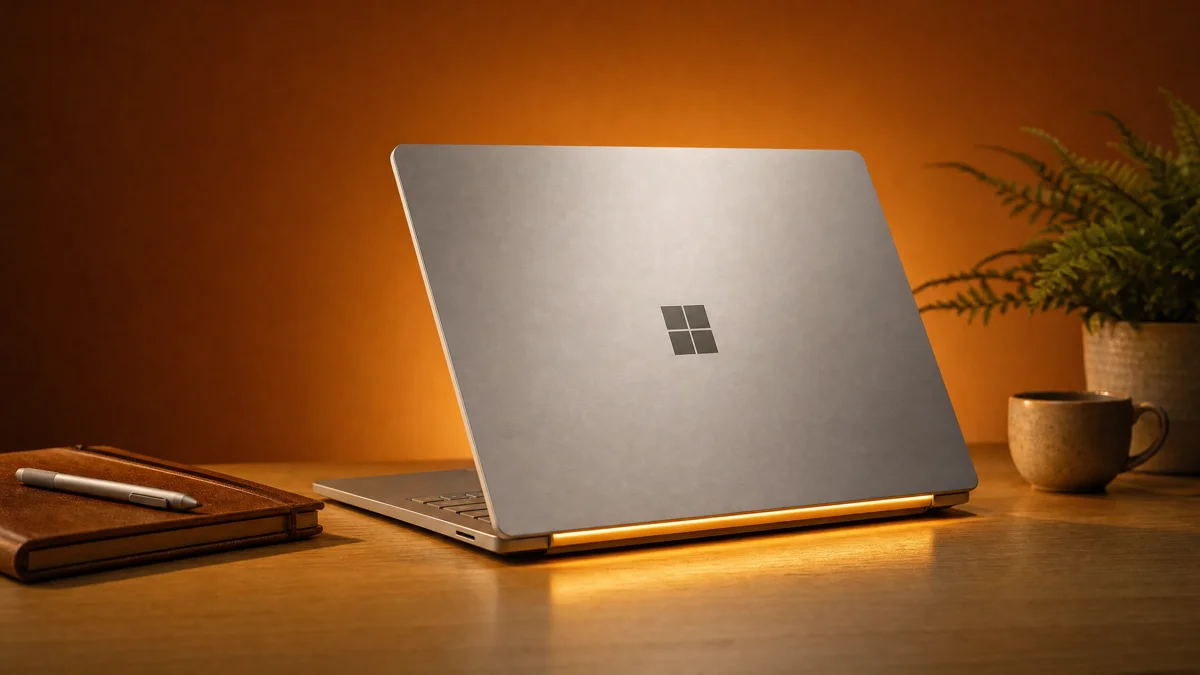
Microsoft has built premium laptops for over a decade — the original Surface Pro redefined the tablet-laptop hybrid, and the Surface Laptop set the standard for Windows build quality. But Microsoft never made the one hardware decision that would have genuinely differentiated Surface from every other Windows machine: committing to a CPU and GPU architecture built for AI from the ground up. That changes with the Surface Laptop Ultra, announced at Computex 2026 as the first Microsoft laptop co-developed with NVIDIA from silicon to operating system. It runs the RTX Spark superchip, and it carries the one spec that makes it genuinely different from every other Windows laptop on the market: native CUDA support.
Specifications
- Processor: NVIDIA RTX Spark — 20-core ARM Grace CPU
- GPU: Blackwell — 6,144 CUDA cores, roughly equivalent to an RTX 5070
- Memory: up to 128GB unified LPDDR5X
- Memory bandwidth: roughly 300 GB/s
- AI performance: 1 petaflop (FP4)
- Max local model: roughly 120 billion parameters
- Display: 15" mini-LED PixelSense Ultra, 2880×1920, 2,000 nit peak brightness
- Weight: roughly 2 kg (4.4 lbs)
- OS: Windows 11 on ARM
- Launch: second half of 2026, starting around $2,500
How It Actually Compares to a MacBook Pro
Set side by side with a MacBook Pro M5 Max, the Surface Laptop Ultra wins on CPU core count (20-core ARM Grace vs. 16-core Apple Silicon), GPU (6,144 CUDA cores vs. a 40-core Apple GPU — and the CUDA ecosystem is decisive for most ML work), AI performance (1 petaflop FP4 vs. roughly 38 TOPS on Apple's Neural Engine), display peak brightness (2,000 nit mini-LED vs. 1,600 nit Liquid Retina XDR), and native CUDA support, which the MacBook simply doesn't have. Memory capacity ties at up to 128GB unified, and starting price ties at roughly $2,500.
Apple wins clearly on one number that matters: memory bandwidth, at 546 GB/s versus 300 GB/s — a real gap for memory-intensive workloads like LLM inference with large batch sizes. macOS ecosystem integration and battery longevity also remain Apple advantages built from years of hardware-software co-design that Windows on ARM is still catching up to. But for the specific audience this machine targets, the CUDA win outweighs all of that.
What CUDA Actually Means in Practice
Native CUDA support means PyTorch, TensorFlow, RAPIDS, cuDNN, and the entire machine-learning stack run on this GPU without adaptation, emulation, or community workarounds — every AI development workflow built over the past decade assumes a CUDA-capable device, and the Surface Laptop Ultra is the first laptop that satisfies that assumption portably. Apple's Metal-based stack (MLX, Core ML, Metal Performance Shaders) is capable and improving fast, but it isn't CUDA, and thousands of research papers and production systems written with CUDA as the default require real porting work to run on it.
- Fine-tuning a 7B model with standard PyTorch training scripts: works natively
- Running inference via vLLM, SGLang, or llama.cpp with CUDA acceleration: works natively
- Using RAPIDS for GPU-accelerated data science: works natively
- Developing and testing CUDA kernels directly on the laptop: works natively
Where Apple Still Has the Edge
This isn't a MacBook Pro replacement for most users. Apple still leads on memory bandwidth for throughput-bound workloads like large matrix operations; on battery life and thermals, where the M5 Max benefits from years of co-designed silicon and OS while RTX Spark on Windows will face real scrutiny at launch; and on software maturity, since Logic Pro, Final Cut Pro, Lightroom, and dozens of other professional apps have been tuned for Apple Silicon specifically, while Windows-on-ARM equivalents vary in polish. The MacBook Pro M5 Max is also shipping today, while the Surface Laptop Ultra doesn't launch until the second half of 2026.
One honest caveat: Windows-on-ARM compatibility with legacy x86 software remains imperfect in 2026. Major applications — Office, Adobe Creative Suite, major browsers, most developer tools — run natively or through translation at reasonable performance, but enterprise software and some hardware-dependent utilities still have gaps worth checking before committing. That isn't specific to this machine; it's the inherited state of Windows on ARM generally.
Who It Is Actually For
This machine is a better laptop than any MacBook for a specific profile: AI developers and researchers who need CUDA portability without carrying a separate workstation GPU; engineers running PyTorch or TensorFlow training locally, where 128GB of unified memory and 1 petaflop of FP4 compute make fine-tuning 7B models and running 120B-parameter inference feasible without renting cloud GPUs; enterprise teams building internal AI applications that need GDPR- or CCPA-compliant local inference with no cloud exposure; and Windows-first creative professionals who need real GPU performance for 3D rendering and video without switching to macOS. For general productivity and the most mature software ecosystem, the MacBook Pro M5 Max remains the stronger pick — and Microsoft is positioning the Ultra alongside the rest of the Surface lineup, not as its replacement.
Surface Laptop Ultra launches in the second half of 2026 starting at roughly $2,500, with top-spec builds — 128GB memory, the maximum GPU configuration — expected to exceed $4,000 through Microsoft retail and major US retailers. Unlike some Computex announcements, this is a confirmed production machine with OEM commitments and a real supply chain, not a concept render.